What an Outsourced CFO Actually Does for Growing Businesses
At a certain point, financial questions stop being simple.Early on, most businesses are focused on momentum customers, revenue, and keeping the lights on. Financial reporting exists, but largely as confirmation. Later, the same numbers start to feel heavier. Decisions begin to carry longer consequences. Trade-offs become real.
That’s usually when the idea of an outsourced CFO comes up. Not because something is broken. More often because the business has reached a stage where interpretation matters more than record-keeping. And that distinction is where outsourced CFO services are often misunderstood
Understanding the Outsourced CFO Role in Practice
The outsourced CFO is not a bookkeeper. It’s also not a part-time accountant with a different title. In reality, it occupies a very awkward space that is above the finance operations but below the management. This space is occupied deliberately..
The outsourced CFO is a service that is meant to offer financial leadership without financial ownership. The service is advisory, situational, and sometimes very inconvenient. It is a service that asks questions rather than provides answers.
None of this shows up neatly on a task list. And that’s part of why the role is often misread.
When Businesses Typically Consider an Outsourced CFO
Accounting: It tells you what has already happened. It seems obvious, but many companies don’t realize the constraint until they experience it. The reports come on time. The numbers add up. The compliance is taken care of. And yet, the leadership is still left in doubt.
Common moments:
- Revenue is growing, but cash feels tight more often than expected
- Costs look reasonable individually, but margins keep thinning
- Forecasts exist, but no one trusts them fully
- Decisions get delayed because “we need to see the numbers again”
This is usually where outsourced CFO services start to make sense. Not because accounting failed but because decision-making outgrew it.
What an Outsourced CFO Spends Time On
The work itself is rarely dramatic. It’s quiet, repetitive in places, and occasionally frustrating. But it’s also where clarity tends to emerge.
Financial Planning and Analysis :
Budgeting and forecasting are often treated like formal exercises. In reality, they’re ongoing conversations. An outsourced CFO focuses less on producing perfect models and more on understanding assumptions. Where are they coming from? How fragile are they? What breaks if they’re wrong? Financial planning and analysis, when done well, isn’t predictive. It’s preparatory.
Management Reporting That Someone Actually Reads
Most management team reports are technically correct and simply go unread. Outsourced CFOs spend time reformatting reports so that they align with how decisions are made, not how accounting systems are organized. This could mean fewer metrics, not more. Or organizing information differently. Or pointing out anomalies that don’t fit the story. It’s not about adding complexity. It’s about subtracting noise.
Cash Flow Oversight (Not Cash Management) :
There’s a key distinction here. Outsourced CFO services rarely involve managing payments or collections. What they offer instead is insight. Timing. Sequence. Pressure points that aren’t reflected in profit statements. Cash flow management is all about understanding when money counts, not just how much.
When Businesses Start Looking for This Support
There’s no universal trigger. Some businesses consider an outsourced CFO for startups after raising capital. Others do it much later, when growth slows and questions become sharper. SMEs often reach the point when informal financial oversight starts to feel risky.
Typical signals:
- Decisions feel financially significant, but poorly framed
- Founders are too close to the numbers to challenge them objectively
- External stakeholders want clearer financial narratives
- Hiring a full-time CFO feels premature, but doing nothing feels worse
That’s where part-time CFO services tend to fit.
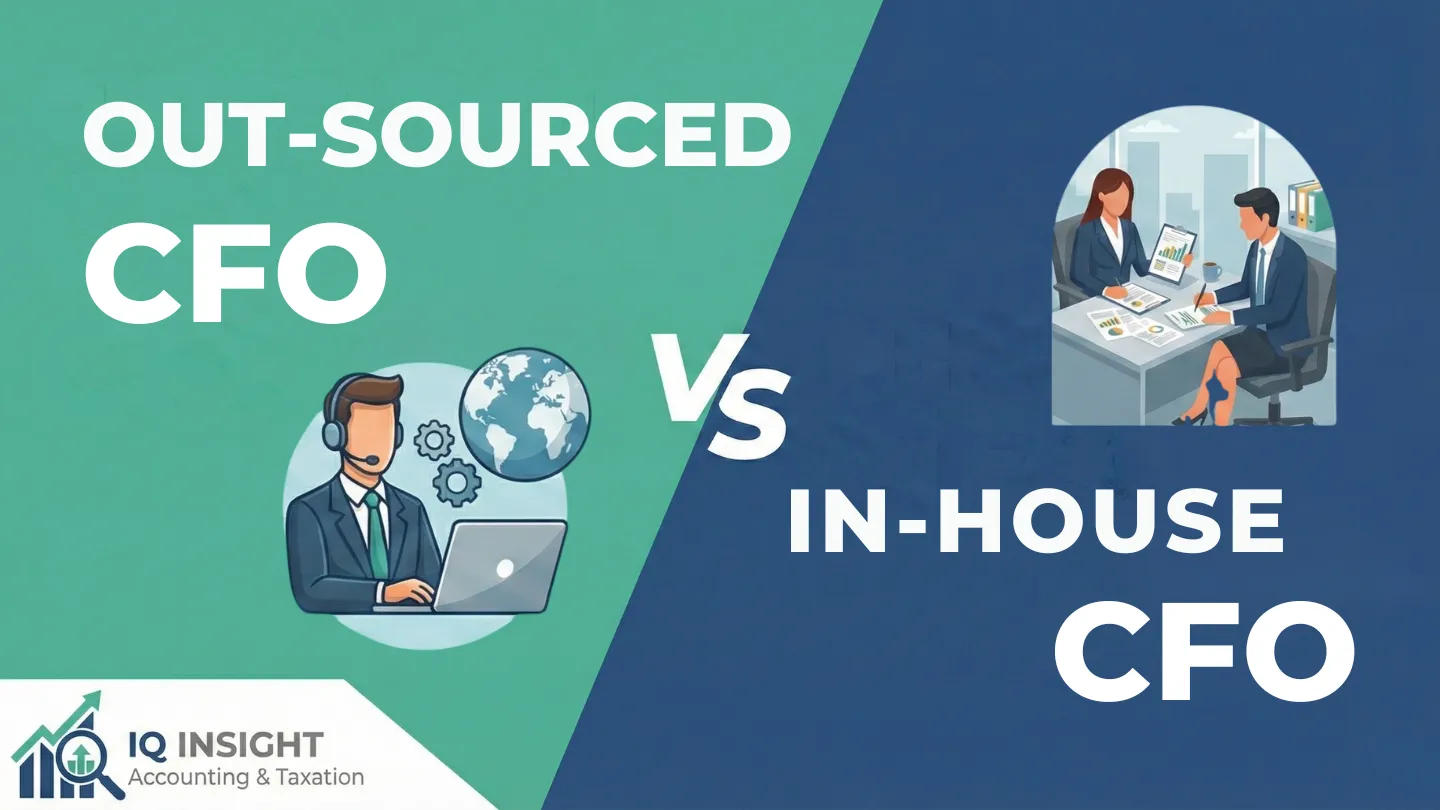
Outsourced CFO vs In-House CFO: A Practical Difference
This comparison is often framed around cost. That’s not the most useful lens.
- An in-house CFO owns execution, teams, systems, and outcomes. They live inside the business. That depth is powerful but also heavy.
- An outsourced CFO stays outside the operational gravity. Time is limited. Scope is defined. The focus stays on financial decision support, not organisational management.
For many growing businesses, that distance is helpful. It creates space for honest conversations that are harder to have internally.
Misunderstandings That Create Friction
One common assumption is that outsourced CFO services come with answers. They don’t. They come with frameworks, questions, and structured thinking. Another is that the role exists to accelerate growth. In reality, it often does the opposite first, slowing decisions down just enough to make them deliberate. And finally, there’s the belief that outsourced CFOs are only useful during fundraising or crisis. Those moments highlight the value, but they’re not the only ones.
Stable periods benefit too. Sometimes more so.
Scope, Boundaries, and Professional Responsibility
CFO advisory services with integrity are mindful of boundaries. CFOs outsourced do not substitute tax consultants. They do not offer legal opinions. They do not make executive decisions. And unless specifically retained, they do not assume statutory obligations. What they offer is informed financial leadership support that is experience-driven, caution-infused, and governance-compliant.
That restraint isn’t a weakness. It’s part of the role.
How the Role Evolves With the Business
In the early stages, financial management is all about survival.
Later, it is about sustainability. Then it is about resilience. Then it is about optionality. The CFO outsourcing service evolves through all these stages. In the early stages, for startups, it may be about runway and scenario planning. For SMEs, it is about the quality of reporting and financial controls. For more established companies, it is about strategic financial management and long-term planning. Then, of course, some companies will have grown out of the service and take financial management in-house. Others won’t. And that’s not a failure.
Why External Perspective Still Matters
One of the quieter benefits of an outsourced CFO is independence. Not independence from the business but from its internal momentum. That distance allows financial conversations to stay grounded, even when everything else feels urgent. It’s not about being pessimistic. It’s about being precise.
How This Connects to CFO Advisory Services
In a larger advisory context, outsourced CFO work is most effective when it complements strong accounting, compliance, and governance infrastructure. It’s not a transformational function. It’s a stablishing function. A clarifying function. Sometimes an uncomfortable function. Often a necessary function. And typically most useful before things become apparent.
Closing Thought
An outsourced CFO doesn’t exist to tell businesses what to do.The role exists to make sure leadership understands the financial shape of the decisions they’re already making.
For growing businesses, that understanding tends to matter more than speed, polish, or optimism. It’s what allows confidence to rest on something solid.